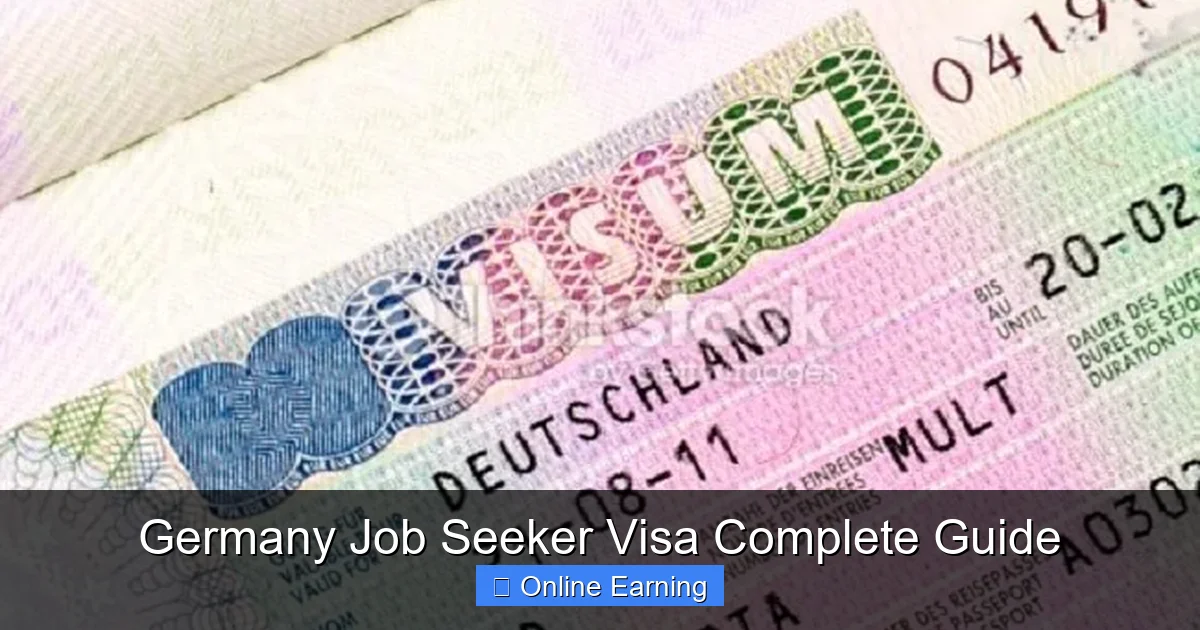
The Germany Job Seeker Visa is a powerful tool for international professionals seeking employment in Germany. It allows you to live and search for a job for up to six months, with the possibility of extension and eventual residency. Whether you’re a graduate, skilled worker, or freelancer, this visa opens doors to Europe’s strongest economy.
Germany has long been a magnet for talent from around the world. With its robust economy, high quality of life, and strong social safety net, it’s no surprise that millions of foreigners dream of working in the country. For many, the first step is the Germany Job Seeker Visa—a unique opportunity to live and work in one of Europe’s most dynamic labor markets. Unlike traditional work visas, this visa isn’t tied to a specific employer. Instead, it gives you the freedom to search for a job on your own terms. Whether you’re a recent graduate, a mid-career professional, or someone looking to restart your career, this guide will walk you through everything you need to know.
In this comprehensive guide, we’ll break down the application process, eligibility criteria, and practical tips to help you succeed. We’ll also explore what happens after you land a job and how to transition smoothly into long-term employment. Think of this as your personal roadmap to Germany’s job market—tailored, practical, and full of insider knowledge. Let’s get started.
Key Takeaways
- Eligibility Requirements: You must have a university degree, sufficient funds (€1,027/month), and health insurance. Non-EU citizens need a valid passport.
- Visa Validity: Initially valid for up to 6 months, it can be extended once under specific conditions, such as proving active job searches.
- Job Search Process: Use platforms like LinkedIn, StepStone, and German job boards. Networking and understanding German workplace culture are key.
- Transition to Work Visa: Once you secure a job offer with a salary of at least €58,500 (or €45,552 for shortage occupations), you can switch to a work visa.
- Path to Permanent Residency: After 21–33 months of employment with B1 German language skills, you can apply for permanent residency.
- Costs and Fees: Expect visa fees of €75–€100, plus translation, certification, and travel expenses.
- Tips for Success: Improve your German, tailor your CV to German standards, and consider internships or volunteer work to gain local experience.
📑 Table of Contents
- What Is the Germany Job Seeker Visa?
- Who Is Eligible for the Germany Job Seeker Visa?
- How to Apply for the Germany Job Seeker Visa
- Living in Germany While Job Hunting
- Extending Your Job Seeker Visa
- Transitioning to a Work Visa
- Path to Permanent Residency
- Tips for Success on the Germany Job Seeker Visa
- Common Mistakes to Avoid
- Conclusion
What Is the Germany Job Seeker Visa?
The Germany Job Seeker Visa is a temporary residence permit designed for non-EU nationals who want to search for employment in Germany. It’s officially known as the “Visa for the Purpose of Job Search” and is issued by German embassies or consulates abroad. This visa allows you to stay in Germany for up to six months (and sometimes longer) without having a job offer in hand. It’s a rare opportunity in the global immigration landscape—most countries require a job offer before issuing a work visa.
The visa is particularly popular among university graduates, IT professionals, engineers, and other skilled workers. Germany faces a shortage in many sectors, and the government wants to attract global talent. That’s why the Job Seeker Visa is so valuable. It’s not just a stopgap—it’s a strategic move toward long-term integration.
How Does It Differ From Other Visas?
Unlike the standard work visa, which requires a confirmed job offer and often a labor market test, the Job Seeker Visa gives you the freedom to explore opportunities. You don’t need to prove you’ve already found a job. Instead, you must show that you’re actively seeking one and have the means to support yourself during your stay.
It’s also different from student visas or tourist visas. A tourist visa doesn’t allow you to work or search for a job, and a student visa restricts you to academic activities. The Job Seeker Visa bridges the gap between education and employment, making it ideal for recent graduates.
Who Is Eligible for the Germany Job Seeker Visa?
Visual guide about Germany Job Seeker Visa Complete Guide
Image source: germany-visa.org
Not everyone can apply for this visa. Germany has specific requirements to ensure that applicants are serious job seekers with a realistic chance of finding work. Let’s go over the key eligibility criteria.
1. Educational Qualification
You must have a recognized university degree. This doesn’t have to be from Germany—any accredited degree from a recognized institution is acceptable. For example, if you graduated from a top university in India, the U.S., or Canada, you’re likely eligible. However, your degree must be relevant to the field you’re seeking employment in.
2. Financial Requirements
You need to prove you can support yourself during your stay. As of 2024, you must show evidence of at least €1,027 per month. This amount is based on Germany’s minimum income requirement for residency. You can meet this by:
– Having a blocked account (Sperrkonto) with €12,324 (€1,027 × 12 months) deposited.
– Showing a scholarship letter.
– Having a job offer with a salary above the threshold.
– Being sponsored by a family member in Germany.
3. Health Insurance
Health insurance is mandatory. You must have valid coverage for the entire duration of your stay. This can be German public health insurance (like TK or AOK) or international private insurance that meets German standards. Without it, your application will be rejected.
4. Clean Criminal Record
You need a clean criminal record. This is verified through a police clearance certificate from your home country and any country where you’ve lived for more than six months in the past five years.
5. Valid Passport
Your passport must be valid for at least three months beyond your intended stay in Germany. It should also have at least two blank pages for visa stamps.
6. Purpose of Stay
You must demonstrate that your primary goal is to search for a job in Germany. This means you shouldn’t plan to stay longer than necessary or engage in other activities, like tourism or studying.
How to Apply for the Germany Job Seeker Visa
Visual guide about Germany Job Seeker Visa Complete Guide
Image source: blog.visasavenue.com
The application process is straightforward but requires careful preparation. Here’s a step-by-step guide.
Step 1: Gather Required Documents
Prepare the following:
– Completed visa application form
– Valid passport (with blank pages)
– Passport-sized photos (recent, white background)
– University degree and transcripts (translated into German or English if needed)
– Proof of financial means (blocked account, scholarship, or job offer)
– Health insurance confirmation
– Police clearance certificate
– Motivation letter explaining why you want to work in Germany
– CV in German or English (tailored to German standards)
Step 2: Book an Appointment
Visit the website of the German embassy or consulate in your country. Book an appointment for a visa interview. Be sure to apply at least 3–4 weeks before your intended travel date.
Step 3: Attend the Interview
During the interview, you’ll meet with a consular officer. They’ll ask about your background, your degree, and your job search plans. Be honest and enthusiastic. Show that you’ve researched Germany’s job market and understand the challenges.
Step 4: Wait for Approval
Processing usually takes 1–3 weeks. If approved, you’ll receive your visa within a few days. Keep your passport safe—you’ll need it to travel.
Step 5: Travel to Germany
Once you arrive, register your address at the local Bürgeramt (citizen’s office) within two weeks. This is required for legal residency.
Living in Germany While Job Hunting
Visual guide about Germany Job Seeker Visa Complete Guide
Image source: blogger.googleusercontent.com
Once you’re in Germany, your real work begins—the job search. Here’s how to make the most of your time.
1. Register with Federal Employment Agency (BA)
Even though you’re not officially employed, you should register with the Federal Employment Agency (Bundesagentur für Arbeit). They offer free job search assistance, including workshops, language courses, and career counseling. It’s a great way to connect with local employers.
2. Use Online Job Portals
Germany has some of the best job platforms in the world. Here are the top ones:
– **StepStone**: The most popular job site in Germany.
– **Indeed Germany**: Aggregates listings from various sources.
– **Xing**: A professional network similar to LinkedIn.
– **Karriere.at and Monster.de**: Also widely used.
Set up alerts for jobs in your field. Use keywords like “Softwareentwickler,” “Marketing Manager,” or “Data Analyst” depending on your role.
3. Network Locally
Attend job fairs, industry events, and meetups. Networking is crucial in Germany. Many jobs are filled through referrals. Join LinkedIn groups, attend German-language events, and connect with alumni from your university.
4. Learn German
While English is widely spoken in cities, knowing German significantly increases your chances. Many companies prefer candidates with B1 or B2 level German. Enroll in a language course—many are free or subsidized for job seekers.
5. Tailor Your CV and Cover Letter
German CVs (Lebenslauf) are different from others. They’re typically one page, include personal details, education, work experience, and skills—but no photos or marital status. Your cover letter (Anschreiben) should be concise and highlight your motivation and fit for the role.
Extending Your Job Seeker Visa
Your initial visa is valid for six months. But what if you don’t find a job in time?
Conditions for Extension
You can apply for an extension if:
– You’ve been actively searching for a job.
– You can still support yourself financially.
– You’ve improved your German or gained relevant experience (e.g., internship, volunteer work).
The extension is usually granted for another six months. This gives you more time to find a suitable position.
Important Notes
– You cannot work during the extension period unless you have a work permit.
– The extension is not guaranteed—you must prove your job search efforts.
– If you leave Germany before finding a job, you may not be able to re-enter with the same visa.
Transitioning to a Work Visa
Once you land a job, the next step is to switch to a work visa. This process is smoother if you’ve already established residency in Germany.
1. Secure a Job Offer
You need a formal job offer from a German employer. The salary must meet the minimum threshold—currently €58,500 per year (€4,875/month) for non-shortage occupations. For in-demand fields like IT, engineering, or healthcare, the threshold is lower (€45,552/year).
2. Employer Submits Application
The employer must apply for a work visa on your behalf. They’ll need to prove they couldn’t find a suitable German or EU candidate (labor market test).
3. Apply for a Residence Permit
Once the work visa is approved, you’ll need to apply for a residence permit at the local Foreigners’ Office (Ausländerbehörde). You’ll also need to provide:
– Employment contract
– Proof of housing
– Health insurance
– Clean criminal record
4. Start Working
After approval, you can begin working. You’ll receive a residence permit with a validity period matching your employment contract.
Path to Permanent Residency
Germany offers one of the most straightforward paths to permanent residency in Europe. After working legally for a few years, you can apply for a permanent residence permit (Niederlassungserlaubnis).
Requirements for Permanent Residency
– At least 21 months of employment (if you have B1 German)
– 33 months (if you only have A2 German)
– Stable income above the minimum threshold
– Clean criminal record
– Health insurance
– Integration into German society (language, knowledge of society)
Benefits of Permanent Residency
– No need to renew your permit every few years
– Freedom to work in any EU country
– Path to German citizenship after 8 years
– Access to social benefits
Tips for Success on the Germany Job Seeker Visa
Here are some practical tips to increase your chances of success.
1. Start Early
Begin your job search before you leave your home country. Update your LinkedIn profile, connect with German professionals, and research companies.
2. Learn Basic German
Even basic phrases can open doors. Many companies value language skills, and it shows you’re serious about integration.
3. Consider Internships or Freelancing
If full-time roles are hard to find, consider internships or freelance work. This builds experience and helps you network.
4. Use Free Resources
Take advantage of free services like the Federal Employment Agency, language courses, and job fairs.
5. Stay Positive and Persistent
Job searching in a foreign country is challenging. Stay focused, learn from rejections, and keep applying.
Common Mistakes to Avoid
– Applying without proper documents
– Overstaying your visa
– Not registering your address
– Trying to work without a permit
– Ignoring German workplace culture
Conclusion
The Germany Job Seeker Visa is more than just a piece of paper—it’s a gateway to one of the world’s most vibrant economies. With careful planning, persistence, and the right mindset, you can turn this opportunity into a fulfilling career in Germany. From meeting eligibility requirements to navigating the job market and transitioning to permanent residency, this guide has covered every step. Remember, success doesn’t happen overnight. But with the right approach, you can build a life in Germany that’s rewarding, stable, and full of possibilities.
Frequently Asked Questions
Can I work while on a Germany Job Seeker Visa?
No, you cannot work during your job seeker visa unless you have a separate work permit. The visa is specifically for job searching only. However, you can volunteer, do internships, or take short courses to improve your skills.
How long does the application process take?
The application process typically takes 1–3 weeks after your interview. You should apply at least 3–4 weeks before your intended travel date to allow time for processing and travel.
What happens if I don’t find a job in 6 months?
You can apply for a one-time extension of up to 6 months if you’ve been actively job searching and meet financial requirements. You must prove your efforts and show progress in your search.
Do I need to speak German to get a job in Germany?
While many tech and multinational companies hire English speakers, knowing German increases your chances significantly. For most roles, B1 level German is recommended.
Can I bring my family with me on a Job Seeker Visa?
No, your family cannot accompany you on a Job Seeker Visa. They would need their own visas, such as a family reunion visa, which requires different requirements.
Is the Job Seeker Visa available for all countries?
Yes, the visa is available to citizens of most non-EU countries, including the U.S., Canada, India, China, and many others. Check with your local German embassy for specific details.