Moving to Australia permanently? This guide walks you through each step of the Australia Permanent Residency (PR) visa process—from choosing the right visa subclass to submitting your application and preparing for life Down Under. Whether you’re a skilled worker, family member, or investor, understanding the process helps you avoid common pitfalls and speed up your journey to becoming a permanent resident. With clear, up-to-date steps and practical advice, you’ll be ready to take action confidently.
Key Takeaways
- Eligibility is key: Most PR visas require skills assessment, English proficiency, health checks, and character requirements. Each subclass has its own criteria.
- Points-based system: The General Skilled Migration (GSM) program uses a points test to rank applicants based on age, education, work experience, and language skills.
- Skills assessment: You must have your occupation assessed by the relevant Australian authority before applying for most skilled visas.
- Expression of Interest (EOI): Submit an EOI through SkillSelect to enter the pool and be invited to apply for a visa.
- Visa processing times vary: Processing can take months to over a year depending on the visa subclass and your individual circumstances.
- Post-landing obligations: Most PR visas require you to live, work, or study in Australia for a certain period (residency obligation) to maintain your status.
📑 Table of Contents
- Australia Permanent Residency Visa Steps: Your Roadmap to Living and Working in Australia
- Understanding Australia Permanent Residency: What It Means
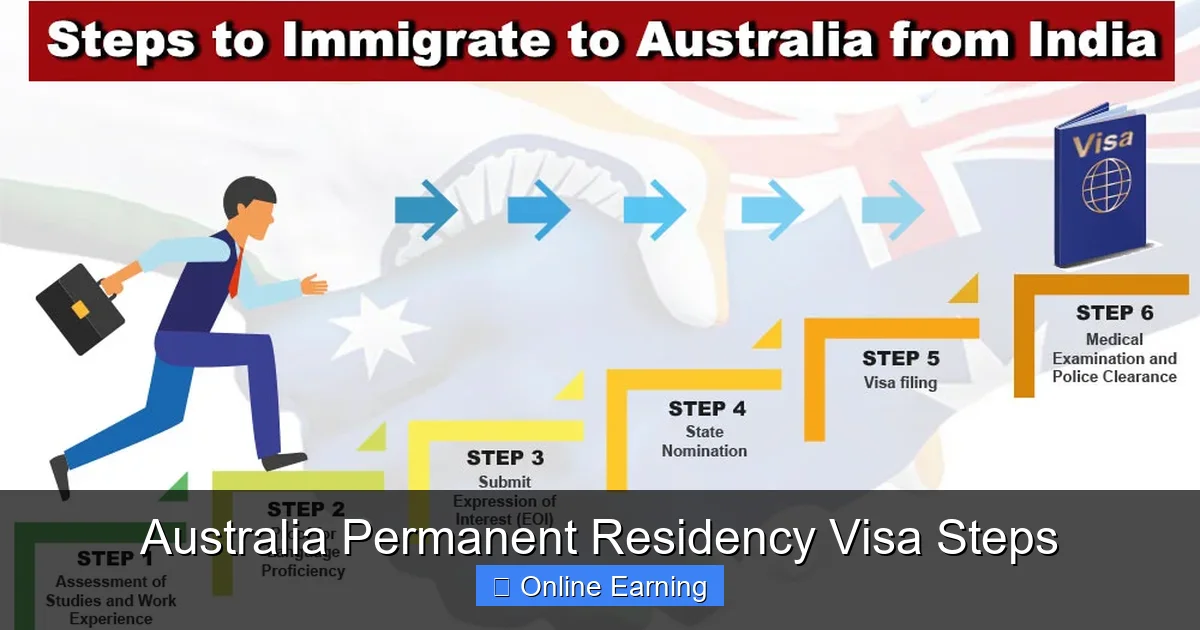
- Step 1: Determine Your Eligibility and Choose the Right Visa Subclass
- Step 2: Take Required Assessments and Tests
- Step 3: Submit an Expression of Interest (EOI)
- Step 4: Receive an Invitation and Apply for the Visa
- Step 5: Wait for Processing and Decision
- Step 6: Receive Your Visa and Fulfill Residency Obligations
- Step 7: Plan Your Move and Settle in Australia
- Common Mistakes to Avoid
- Final Thoughts: Your Journey Starts Now
Australia Permanent Residency Visa Steps: Your Roadmap to Living and Working in Australia
Dreaming of sun-drenched beaches, world-class cities, and a high standard of living? Australia offers a welcoming, multicultural society and strong job markets—making it one of the most sought-after destinations for skilled migrants. But how do you turn that dream into reality? The answer lies in understanding the Australia Permanent Residency Visa steps. This comprehensive guide breaks down the entire process into clear, actionable stages so you can navigate the system with confidence.
Whether you’re a young professional looking to advance your career, a family wanting to reunite, or an investor seeking long-term opportunities, this article covers everything from eligibility checks to visa approval. We’ll walk you through each phase—what to prepare, how to apply, and what to expect along the way. By the end, you’ll have a solid understanding of the journey ahead and the tools to make informed decisions.
Understanding Australia Permanent Residency: What It Means
Before diving into the steps, it’s important to understand what permanent residency actually means in the Australian context. A Permanent Resident (PR) visa allows you to live, work, and study anywhere in Australia indefinitely. You can also access public healthcare (Medicare), enroll children in government schools, and eventually apply for Australian citizenship after meeting residency requirements.
Visual guide about Australia Permanent Residency Visa Steps
Image source: images-wixmp-ed30a86b8c4ca887773594c2.wixmp.com
However, unlike citizenship, PR status doesn’t automatically grant you a passport or voting rights. It’s a powerful step toward belonging, but it comes with responsibilities—like fulfilling residency obligations and obeying Australian laws. Most importantly, PR is not a one-time event; it’s a status you must maintain through compliance and renewal (for certain visas).
Step 1: Determine Your Eligibility and Choose the Right Visa Subclass
Know Which Path Fits You Best
Australia offers several pathways to permanent residency, each designed for different profiles. The most common routes include:
Visual guide about Australia Permanent Residency Visa Steps
Image source: australiaprvisa.files.wordpress.com
- Skilled Migration: For workers with in-demand skills. Includes subclasses like 189 (Skilled Independent), 190 (Skilled Nominated), and 491 (Skilled Work Regional).
- Employer-Sponsored: For those with job offers from Australian employers (e.g., 186 Employer Nomination Scheme).
- Family-Sponsored: For partners, parents, or children of Australian citizens or PRs.
- Business/Investment: For entrepreneurs and investors (e.g., Business Innovation and Investment visas).
Your choice depends on factors like your age, skills, occupation, English ability, and whether you have family or job support in Australia.
Check Occupation Availability
If you’re applying under the skilled migration route, your occupation must be on the relevant skilled occupation list (e.g., Medium and Long-term Strategic Skills List or Short-term Skilled Occupation List). You can search the Department of Home Affairs website for the latest lists.
For example, if you’re a software developer, check whether your role is listed under “ICT Business Analysts” or “Software Engineers.” If not, you may need to consider alternative occupations or pathways.
Step 2: Take Required Assessments and Tests
English Language Proficiency
All applicants must prove English proficiency through approved tests like IELTS, TOEFL iBT, PTE Academic, or CAE. Most PR visa subclasses require a minimum score (e.g., IELTS 6.0 in each band for many skilled visas). Retake the test if needed—your score must be valid at the time of application.
Visual guide about Australia Permanent Residency Visa Steps
Image source: australiaprvisa.files.wordpress.com
Tip: Some professions (like nursing or teaching) require higher scores or additional language tests.
Skills Assessment
This is mandatory for most skilled visas. You’ll need to submit evidence that your qualifications and work experience match the Australian standards for your occupation. The assessing authority varies by profession—for example:
- Engineers Australia for engineering roles
- Australian Computer Society (ACS) for IT professionals
- CPA Australia or CA ANZ for accounting
Start this early—assessments can take weeks or months. Keep all documents updated and ensure your experience letter includes job duties, duration, and employer details.
Health and Police Checks
You must undergo medical exams and provide police clearance certificates from every country you’ve lived in for 12 months or more in the past decade. These are standard checks to ensure public safety and health security.
Pro tip: Get your health check from a panel physician approved by the Department of Home Affairs. For police checks, visit your local embassy or use online services like Australian Federal Police.
Step 3: Submit an Expression of Interest (EOI)
What Is an EOI?
An Expression of Interest (EOI) is your entry ticket into the visa selection system. You submit personal, educational, and professional details through SkillSelect—a government portal for skilled migration.
Your EOI includes:
- Basic personal information
- Skills, qualifications, and work experience
- English test results
- State or territory nomination preference (if applicable)
How to Submit Your EOI
Log in to your SkillSelect account and complete the form. You’ll receive points based on your profile. For instance:
- Age (18–24 = 25 pts, 25–32 = 30 pts, 33–39 = 25 pts)
- English proficiency (e.g., IELTS 8.0 = 20 pts)
- Work experience (overseas = 5 pts, Australia = 10 pts)
- Education (Bachelor’s = 10 pts, Master’s = 15 pts)
Once submitted, you enter a pool. If your points meet the cutoff for a visa subclass (e.g., 189 requires 65+), you may receive an invitation to apply.
Step 4: Receive an Invitation and Apply for the Visa
What Happens After Invitation?
If selected, you’ll get an invitation via email with instructions to lodge your visa application within 60 days. This is your chance to submit all required documents, pay the fee, and complete biometrics (fingerprints and photo).
Important: Missing the deadline means you must re-enter the EOI pool and wait for another invitation—which could take months.
Prepare Your Application Kit
Gather these essential documents:
- Passport copy
- Skills assessment letter
- English test results
- Health and police certificates
- Proof of funds (if required)
- Employment references
- Marriage or birth certificates (if applicable)
Use the Visa Finder tool to confirm exact requirements for your subclass.
Step 5: Wait for Processing and Decision
How Long Does It Take?
Processing times vary by subclass and complexity. As of 2024:
- Subclass 189: 8–12 months
- Subclass 190: 6–10 months
- Subclass 491: 6–10 months
You can track your application status online. If additional information is needed, the department will contact you—respond promptly to avoid delays.
Common Reasons for Delays
- Incomplete documentation
- Background checks taking longer than expected
- High application volume
Tip: Keep copies of all submitted documents and emails. Use a checklist to stay organized.
Step 6: Receive Your Visa and Fulfill Residency Obligations
What Happens After Approval?
Once your visa is granted, you’ll receive an electronic visa grant notice. You’re now a Permanent Resident! You can move to Australia immediately, provided your travel requirements are met (e.g., no travel bans or health restrictions).
Residency Obligation Explained
Most PR visas require you to live, work, or study in Australia for a set period—usually two years. Failure to meet this can result in visa cancellation. Exceptions apply for humanitarian or medical reasons.
For example, Subclass 189 has no formal obligation, but it’s strongly advised to establish roots in Australia. Subclass 491 requires 3 years of regional residence and employment.
Step 7: Plan Your Move and Settle in Australia
Pre-Departure Checklist
- Book flights and arrange temporary accommodation
- Notify banks and transfer funds
- Arrange health insurance (Medicare starts upon arrival)
- Register with Medicare and Centrelink
- Find housing and schools (if applicable)
- Learn about local culture, transport, and laws
First 30 Days in Australia
Within 30 days of arrival, you should:
- Apply for a Tax File Number (TFN)
- Open a bank account
- Get a Medicare card
- Register with a local doctor
- Explore job opportunities (use platforms like Seek, Indeed, or LinkedIn)
Consider joining expat communities or attending settlement services offered by NGOs like Settlement Services International (SSI).
Common Mistakes to Avoid
- Applying without proper documentation: Missing skills assessment or police checks can lead to refusal.
- Incorrect EOI points calculation: Underestimating points may delay your invitation.
- Ignoring processing time updates: Stay informed via the Home Affairs website.
- Not preparing financially: Ensure you have enough funds for initial relocation costs.
Final Thoughts: Your Journey Starts Now
Securing Australia Permanent Residency is a marathon, not a sprint. It requires patience, preparation, and persistence. But with the right roadmap—like the one we’ve outlined—you’re already ahead of the curve.
Remember, every successful PR applicant started exactly where you are: with a dream and a plan. Take it one step at a time. Research thoroughly, seek professional advice if needed, and stay committed to your goal.
Australia is waiting—and your future as a permanent resident is within reach.
Frequently Asked Questions
What is the difference between a temporary and permanent visa in Australia?
A temporary visa allows you to stay in Australia for a limited period (e.g., work or study), while a permanent residency visa grants indefinite stay, access to healthcare, and the ability to work and study anywhere in Australia. PR also opens pathways to citizenship.
How long does it take to get an Australian PR visa?
Processing times vary by subclass. As of 2024, Subclass 189 (Skilled Independent) typically takes 8–12 months, while Subclass 190 (Skilled Nominated) and 491 (Skilled Work Regional) take 6–10 months. Delays can occur due to documentation or high application volumes.
Can I apply for Australian PR without a job offer?
Yes. The General Skilled Migration (GSM) stream—including Subclasses 189, 190, and 491—does not require a job offer. You can apply based on your skills, education, and points. However, some subclasses (like 186) do require employer sponsorship.
Do I need to be under 45 to apply for Australian PR?
Most skilled migration visas favor applicants aged 18–44, but you can still apply at 45 if you have exceptional skills or are nominated by a state/territory. Age is just one factor in the points test.
What happens if my PR visa application is refused?
If refused, you’ll receive a letter explaining the reason. You may be able to appeal or reapply if the issue can be resolved (e.g., missing documents). Some refusals can be reviewed by the Administrative Appeals Tribunal (AAT).
Can I bring my family members to Australia with my PR visa?
Yes. Most PR visas allow you to include dependent family members (spouse, children, or sometimes parents) in your application. They’ll also receive PR status and the same rights as you.