The UK Skilled Worker Visa is your gateway to living and working in the United Kingdom. Whether you’re a nurse, engineer, or software developer, this visa allows you to fill in-demand roles with a licensed employer. But it’s not just about a job offer—you’ll need to meet strict salary, English language, and qualification requirements. Understanding these rules upfront can save you time, money, and heartache. This guide breaks down every requirement in simple terms so you know exactly what to prepare.
Key Takeaways
- You need a job offer from a UK employer with a valid sponsor license. Without this, your visa application won’t be approved.
- Your job must be on the UK Shortage Occupation List or pay the going rate. This ensures you’re not undercutting local wages.
- You must meet the minimum salary threshold—currently £26,200 unless you’re on the Shortage Occupation List. Some roles, like doctors or nurses, have lower thresholds.
- You need to prove your English language skills at an approved level. This is usually IELTS or Trinity ISE with a minimum score.
- You must have a valid Certificate of Sponsorship (CoS) before applying. The employer assigns this, and it’s essential for your application.
- You’ll need to show you have enough savings to support yourself. Usually £1,270 for 28 days before your visa application.
- Your qualifications must match the job role and be assessed if from outside the UK. This includes degree recognition or professional accreditation.
📑 Table of Contents
- What Is the UK Skilled Worker Visa?
- Who Is Eligible for a Skilled Worker Visa?
- How to Apply for the UK Skilled Worker Visa
- What Happens After You Get the Visa?
- Tips to Increase Your Chances of Success
- Common Mistakes to Avoid
- Can You Extend or Switch to the Skilled Worker Visa?
- Final Thoughts: Is the UK Skilled Worker Visa Right for You?
What Is the UK Skilled Worker Visa?
The UK Skilled Worker Visa is the primary work visa for non-EU citizens who want to live and work in the United Kingdom. Introduced in 2020 after Brexit, it replaced the old Tier 2 (General) visa and is designed to attract skilled professionals across a wide range of industries—from healthcare and engineering to IT and education.
This visa allows you to work in a job that’s classified as skilled and requires a degree or higher qualification. It also lets you bring dependents—like your spouse and children—if you meet certain conditions. And if you’ve been in the UK on this visa for five years, you may be eligible for settlement (indefinite leave to remain).
But here’s the thing: the UK government keeps these rules tight to protect the domestic job market. That means the UK Skilled Worker Visa requirements are detailed and can be tricky to navigate if you’re applying for the first time. The good news? Once you understand the basics, the process becomes much clearer.
In this guide, we’ll walk you through every requirement, explain what documents you’ll need, and share tips to increase your chances of success. Whether you’re a recent graduate, a career changer, or a professional relocating from abroad, this article is your one-stop resource.
Who Is Eligible for a Skilled Worker Visa?

Visual guide about Uk Skilled Worker Visa Requirements Explained
Image source: kreweduoptic.com
Not everyone can apply for the UK Skilled Worker Visa. The UK Home Office has set clear eligibility criteria to ensure only qualified, skilled workers fill roles that require specialized knowledge or experience. Let’s break it down.
1. You Must Have a Job Offer from a Licensed Sponsor
The very first requirement is a valid job offer from a UK employer who holds a Tier 2 (General) sponsor license. This license means the employer has been approved by the UK government to hire non-UK workers.
Without this sponsorship, your visa application won’t be accepted. So, your first step should always be finding a job with a sponsor. Some companies are more experienced at sponsoring visas than others—especially in sectors like tech and healthcare.
For example, if you’re a software developer in London, you might apply to companies like Google UK, Amazon, or NHS Digital—they’re all known to sponsor skilled workers. But smaller startups may not have the resources or experience to handle visa sponsorship, so it’s worth asking during interviews.
2. Your Job Must Be Skilled and On a Qualifying Occupation List
Your role must be classified as a skilled job, which means it requires a degree-level qualification or higher, or substantial experience in a specialized field. The UK government publishes a list of eligible occupations, and your job must match one of these.
For instance, roles like accountants, architects, and engineers are typically eligible. But jobs like retail assistants or general administrative roles usually aren’t.
There’s also the Shortage Occupation List (SOL). If your job is on this list, it means the UK has a shortage of workers in that field. Being on the SOL can lower your salary threshold and make it easier to meet the requirements.
3. You Must Meet the Minimum Salary Requirement
The UK sets a minimum salary threshold that you must earn to qualify for the Skilled Worker Visa. As of 2024, this is £26,200 per year.
However, there are exceptions:
– If your job is on the Shortage Occupation List, the minimum salary drops to £20,480.
– If you’re a PhD holder in a STEM (Science, Technology, Engineering, Mathematics) field, you can qualify at £23,960.
– For roles outside of London, the threshold may be lower in some cases, but it’s still generally around £26,200.
Your salary must be paid in full-time equivalent terms. So if you’re offered a part-time role, the pay must be pro-rated to show what a full-time salary would be.
For example, if you’re offered £20,000 for 30 hours a week, the full-time equivalent would be £26,667 (based on 40 hours), which would meet the threshold.
4. You Need to Prove Your English Language Skills
You must prove you can speak, read, write, and understand English at an approved level. This is usually done through:
– IELTS Academic with a minimum score of 4.0 in each component (listening, reading, writing, speaking)
– Trinity College ISE with a Pass in all modules
– A degree taught in English from a recognized institution
If you’re from a majority English-speaking country (like the US, Canada, or Australia), you may be exempt. But always check the official list on the UK government website.
5. You Must Have a Valid Certificate of Sponsorship (CoS)
Once your employer agrees to sponsor you, they’ll issue a Certificate of Sponsorship (CoS). This is a unique reference number that proves your job offer is legitimate and meets government standards.
You’ll need this CoS to apply for your visa. It also helps determine your application fee and immigration health surcharge.
Your employer will assign the CoS after reviewing your qualifications and confirming your role meets the job requirements. Make sure your CoS is issued at least three months before your intended travel date.
6. You Need to Show Proof of Sufficient Funds
The UK government requires you to prove you can support yourself when you arrive. This means having enough savings in your bank account.
As of 2024, you need to show £1,270 in your bank account for at least 28 consecutive days before applying. This amount covers your initial living costs.
If you have a job offer, your employer may also provide a letter confirming they’ll pay you—this can help reduce the amount you need to show.
7. You Must Meet the Maintenance Requirements
In addition to the £1,270, you may need to show more money if you’re bringing dependents. For each dependent, you’ll need an extra £845 per month for up to 91 days.
For example, if you’re bringing your spouse and one child, you’ll need:
– £1,270 (for yourself)
– £845 × 3 months = £2,535 (for your dependents)
So total required: £3,800 in your bank account.
How to Apply for the UK Skilled Worker Visa

Visual guide about Uk Skilled Worker Visa Requirements Explained
Image source: reissedwards.co.uk
Once you meet all the requirements, the application process is straightforward but time-sensitive. Here’s how to do it step by step.
Step 1: Get Your Certificate of Sponsorship
Your employer must assign you a CoS through the UKVI Sponsor Management System. They’ll verify your qualifications and confirm your job meets the skill and salary requirements.
Make sure your CoS includes all required details, like your job title, salary, and start date.
Step 2: Check Your English Language and Qualification Requirements
If your degree wasn’t taught in English or is from outside the UK, you may need to get it assessed by UK NARIC or a professional body.
For example, if you’re a nurse from India, you’ll need to pass the International English Language Testing System (IELTS) and register with the Nursing and Midwifery Council (NMC).
Step 3: Gather Required Documents
You’ll need to submit the following:
– Valid passport
– Certificate of Sponsorship (CoS)
– Proof of English language proficiency
– Academic certificates or job references
– Proof of maintenance (bank statements)
– Tuberculosis (TB) test results (if from a high-risk country)
– Criminal record certificate (if required)
Step 4: Pay the Visa Fee and Immigration Health Surcharge (IHS)
As of 2024, the Skilled Worker Visa fee is £719 for applications made outside the UK. If you’re applying from within the UK, it’s £827.
You’ll also pay the Immigration Health Surcharge (IHS)—currently £624 per year. This gives you access to the UK’s National Health Service (NHS).
Step 5: Complete the Online Application
Fill out the application form on the official UK government website. Upload your documents and pay the fees.
You’ll also need to book a biometric appointment (fingerprints and photo) at a visa application center.
Step 6: Wait for a Decision
Processing times vary, but most applications are decided within 3 weeks if you apply from outside the UK. If you’re applying from inside the UK, it’s usually 8 weeks.
You’ll get an email with your decision and, if approved, your visa grant letter.
What Happens After You Get the Visa?
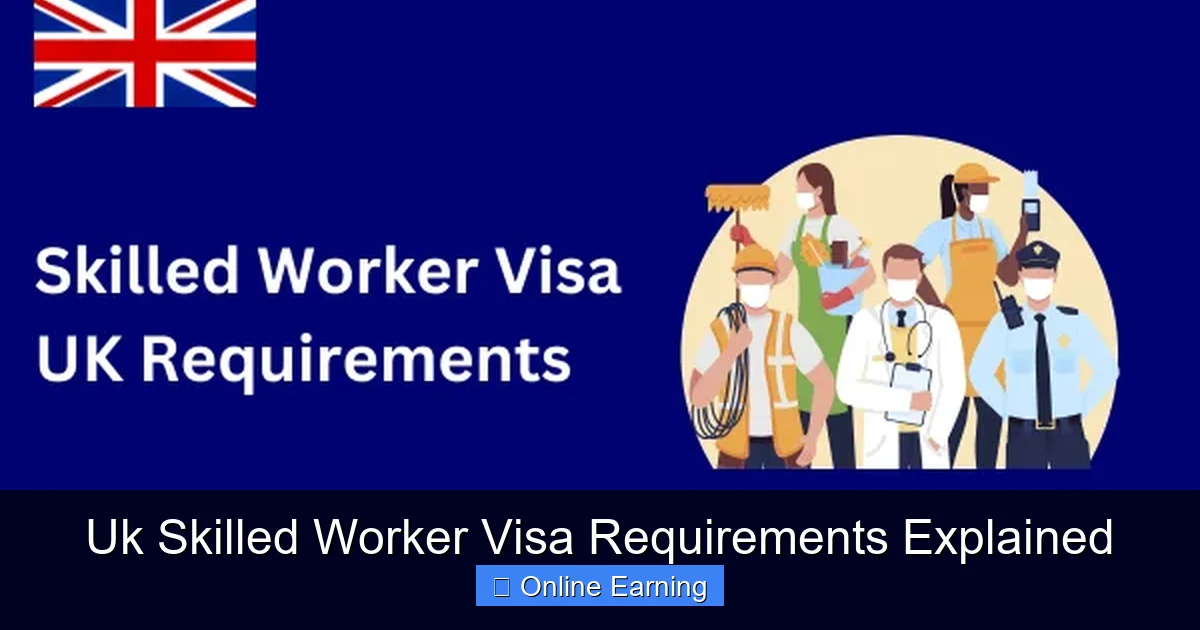
Visual guide about Uk Skilled Worker Visa Requirements Explained
Image source: ukscholarships.uk
Once your visa is approved, you can travel to the UK and start working. Here’s what to expect:
Arrival in the UK
When you arrive, immigration officers may ask about your job, salary, and plans. Be honest and prepared with your documents.
You’ll receive a visa vignette in your passport—this lets you enter the UK. Once you arrive, you’ll get a Biometric Residence Permit (BRP) within 10 days.
Registering with Your Employer
Your employer must record you on their Sponsor Management System within 10 days of your arrival. This is mandatory for compliance.
Accessing Healthcare
Thanks to the IHS, you can register with a local GP (doctor) and access NHS services—just like UK residents.
Bringing Dependents
If you’re bringing family, they’ll apply for their own visas. Your spouse can usually work, but your children can only study full-time unless they’re over 16 and applying independently.
Tips to Increase Your Chances of Success
Applying for the UK Skilled Worker Visa can be competitive. Here are some practical tips to help you succeed:
1. Choose the Right Employer
Not all employers are equally experienced at sponsoring visas. Look for companies with a history of hiring international workers. Ask during interviews: “Do you sponsor skilled worker visas?”
2. Meet the Salary Threshold Early
If your salary is close to £26,200, consider negotiating a higher offer. Even a small increase can make a big difference.
3. Get Your Qualifications Assessed Early
If your degree or professional certification isn’t recognized in the UK, start the assessment process as soon as possible. It can take weeks or months.
4. Prepare Your Documents in Advance
Have your bank statements, English test results, and certificates ready. Missing documents are a common reason for delays.
5. Apply Before Your CoS Expires
CoS are valid for 3 months. Apply as soon as you get it—don’t wait.
6. Be Honest in Your Application
Even minor mistakes can lead to rejection. Double-check all details before submitting.
Common Mistakes to Avoid
Even experienced applicants make errors. Here are the most common ones:
– Not checking if your job is on the eligible occupation list – Always verify your role’s classification.
– Underestimating the salary requirement – Don’t assume your offer will be accepted without meeting the threshold.
– Forgetting to apply for dependents in time – They need their own visa and must apply before you leave.
– Using an expired CoS – The CoS must be issued within the last 3 months.
– Not booking the biometrics appointment – This is required and can’t be skipped.
Can You Extend or Switch to the Skilled Worker Visa?
Yes! If you want to stay longer, you can apply to extend your Skilled Worker Visa as long as you still have a job with your sponsor and meet the requirements.
You can also switch to another visa category, like the Global Talent Visa (for leaders in science or tech) or the Start-up or Innovator Visa (for entrepreneurs).
But remember: you must apply before your current visa expires. Overstaying can lead to fines, bans, or difficulty returning to the UK.
Final Thoughts: Is the UK Skilled Worker Visa Right for You?
The UK Skilled Worker Visa is a powerful opportunity for skilled professionals looking to build a career in one of the world’s leading economies. With its clear pathways to settlement and access to top-tier healthcare and education, it’s a solid long-term plan.
But it’s not easy. The UK Skilled Worker Visa requirements are strict, and the process demands attention to detail. That’s why it pays to start early, work with a knowledgeable employer, and prepare thoroughly.
If you’re serious about moving to the UK, take the time to understand each requirement. Use this guide as your roadmap, and don’t hesitate to consult an immigration lawyer if things get complicated.
With the right preparation, your dream of working in the UK can become a reality. Just remember: the visa is a privilege, not a guarantee—so make sure you’re ready to meet every requirement.
Frequently Asked Questions
What is the minimum salary for a UK Skilled Worker Visa?
The minimum salary is currently £26,200 per year. However, if your job is on the Shortage Occupation List, it drops to £20,480. For PhD holders in STEM fields, it’s £23,960. These thresholds ensure you’re not undercutting local wages.
Do I need a job offer to apply for a Skilled Worker Visa?
Yes, absolutely. You must have a valid job offer from a UK employer with a Tier 2 sponsor license. Without this, your application will be rejected. The job must also meet skill and salary requirements.
How long does it take to get a Skilled Worker Visa?
Processing times vary. If you apply from outside the UK, it usually takes 3 weeks. From inside the UK, it’s typically 8 weeks. Always apply before your current visa expires to avoid overstaying.
Can my family join me on a Skilled Worker Visa?
Yes, your spouse and children can apply to join you. Your spouse can usually work, and your children can study full-time. They’ll need to apply for their own visas and meet maintenance requirements.
Is the UK Skilled Worker Visa renewable?
Yes, you can extend your visa as long as you still have a job with your sponsor and meet the requirements. You can also switch to another visa category if eligible. Always apply before your current visa expires.
Do I need to take a TB test for the Skilled Worker Visa?
Yes, if you’re from a country where TB is common (like India, Nigeria, or Pakistan), you’ll need a TB test from an approved clinic. The results must be included with your application.